
 Technology: Microsoft Foundry
ISV: embedded generative AI for legal document automation
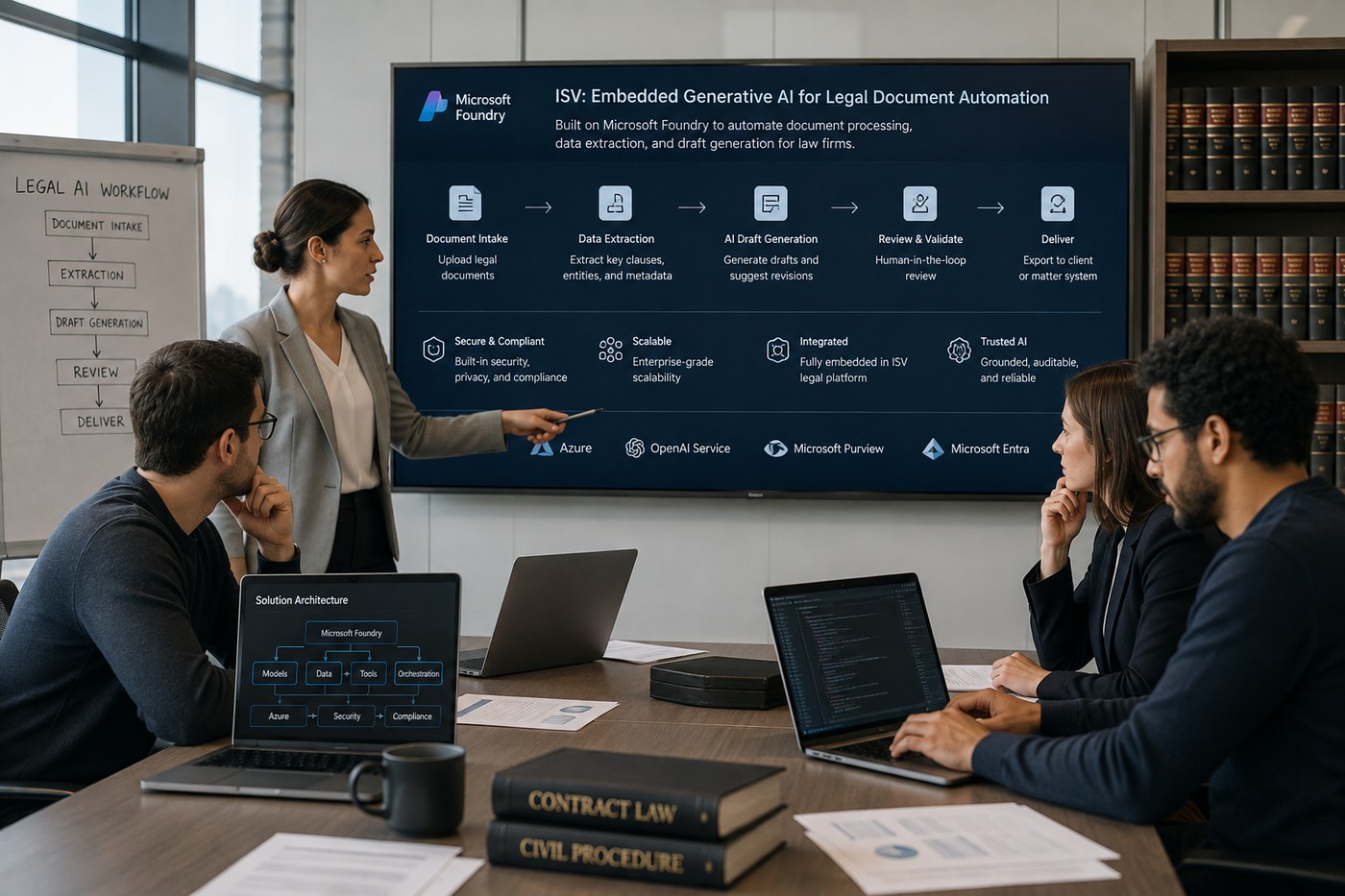
A legal software vendor builds a fully embedded generative AI solution on Microsoft Foundry that automates document processing, data extraction, and draft generation for law firms.
Business challenge
A case management software vendor for law firms saw customers struggle with time-consuming manual tasks: building client profiles, drafting legal correspondence, reviewing extensive documents, tracking expenses, all under strict privacy and compliance requirements. Drafting standard documents cost firms up to forty hours per case.
Architecture
The vendor built the solution entirely on Microsoft Foundry, embedded directly into the existing case management application rather than as a separate add-on. Azure AI Document Intelligence and Azure AI Vision automate data extraction and OCR from forms, identification documents, and invoices. Azure AI Search powers retrieval-augmented generation over a firm's own document library, so the system gives contextual answers grounded in that firm's own case files rather than generic knowledge. Named entity and personal data extraction identify sensitive fields for compliance. Every customer environment is isolated: one firm's data is never visible to another, and input data is deleted immediately after processing under a zero-retention policy.
Why this choice
A separate AI add-on would force lawyers to switch between applications, exactly the problem the solution was meant to remove. Weaving generative AI into the existing workflow instead of making it a standalone module meant users did not have to learn new behavior.
Alternatives
A generic, non-specialized language model without retrieval over a firm's own documents gave answers that sounded like legal advice but were not grounded in the case file itself, unusable in a sector where traceability matters. Fully manual processing remained the status quo, but did not solve the underlying time problem.
Trade-offs
- Full embedding into the existing application speeds adoption, but makes the solution more dependent on that one platform's architecture.
- Zero-retention on input data protects client confidentiality, but limits the ability to improve models afterward based on past interactions.
- Automated data extraction speeds up document processing, but requires training and spot checks so incorrect extraction does not silently flow into a client document.
Microsoft products
Microsoft Foundry, Azure AI Search, Azure AI Document Intelligence, Azure AI Vision.
Best practices
- Embed generative AI into the existing workflow, not as a standalone add-on users have to navigate to separately.
- Use retrieval-augmented generation over a customer's own documents, so answers stay traceable to a source instead of generic knowledge.
- Isolate customer environments strictly and delete input data immediately after processing, especially in sectors with strict confidentiality requirements.
Lessons learned
The biggest efficiency gain did not come from one spectacular feature, but from the sum of small automations: data extraction, OCR, draft generation, and contextual search that together took over a substantial share of the manual work. For firms with twenty users, that amounted to roughly two additional full-time equivalents worth of capacity per year, time that flowed back into client work instead of administration.
Architecture at a glance
Click a component for details
Documents, forms, IDs
Inflow of case files, invoices and identification documents per client firm.
Generative AI is woven into the existing workflow, not a separate add-on users have to navigate to.
Related content
Related how-tos
Related best practices