 Technology: Microsoft Fabric
Healthcare: a single patient view with a Fabric Lakehouse
A hospital group consolidates data from EHR, scheduling and IoT monitoring in a Medallion Lakehouse, with OneLake shortcuts instead of copies.
Business challenge
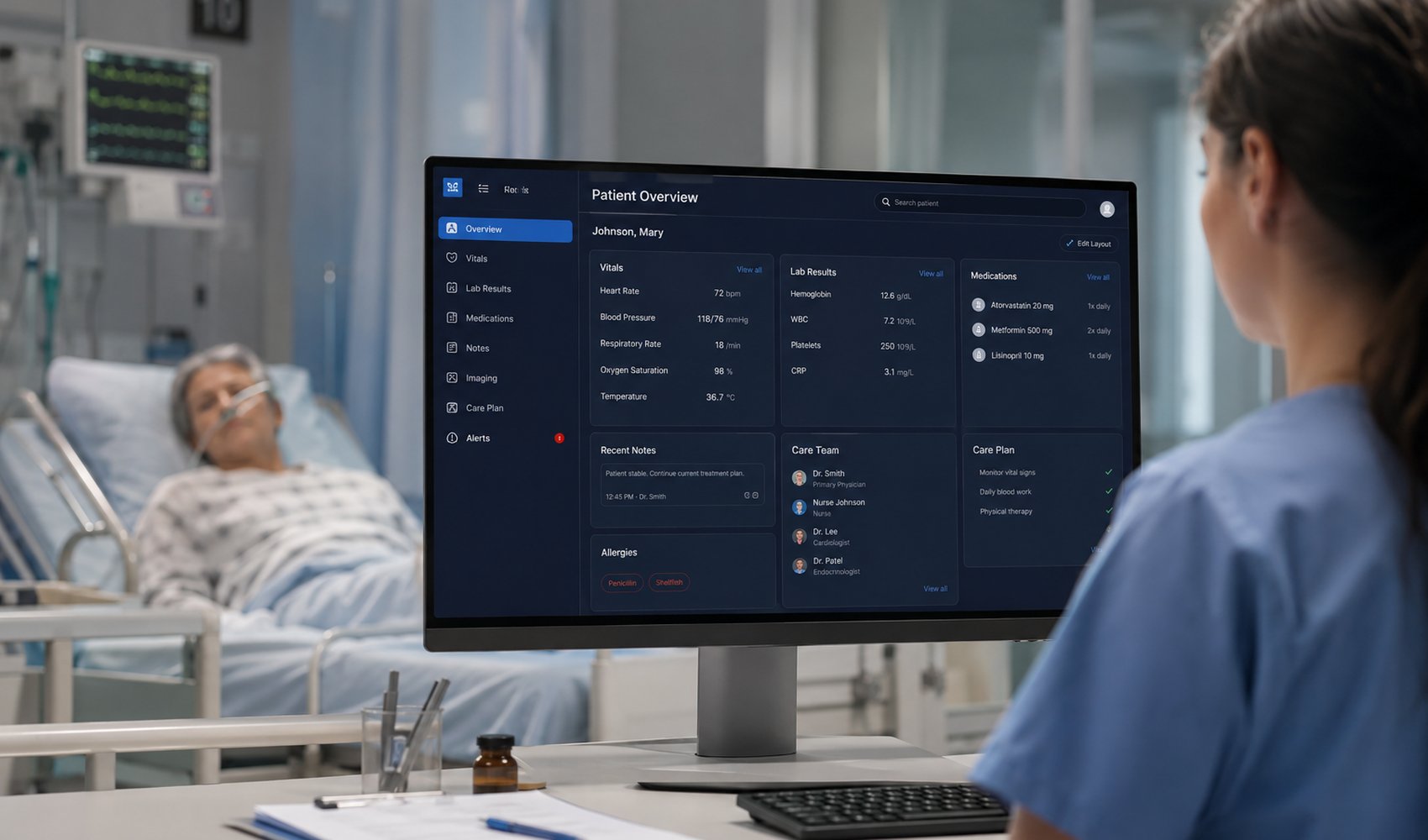
A hospital group with three sites had no unified view of capacity and patient flows. Data was spread across the EHR, the scheduling system and IoT monitoring on nursing wards. Reports took days and contradicted each other, while GDPR and NEN 7510 set strict requirements on where data lives and who can access it.
Architecture
A Microsoft Fabric Lakehouse following the Medallion pattern: source extracts land in Bronze, standardized and pseudonymized data in Silver, and care-specific data models (capacity, throughput, quality) in Gold. Power BI reads directly from Gold via Direct Lake. For the finance administration data warehouse, no copy was deliberately made: a OneLake shortcut surfaces that data in place.
Why this choice
The variety of sources (HL7 messages, tables, sensor data) makes a Lakehouse more logical than a classic Warehouse as the foundation. Pseudonymization in the Silver layer means analysts never work with re-identifiable data, which is the strongest story in audits. Direct Lake avoids Import-mode semantic models that refresh at night and are outdated during the day.
Alternatives
A Fabric Warehouse as the foundation was possible, but forces all sources into a relational straitjacket first. Azure Databricks was technically equivalent, but the organization had no Spark specialists and did have a Power BI team; Fabric lowers that threshold considerably.
Trade-offs
- Direct Lake has hard guardrails per F-SKU on the number of Parquet files, row groups and model size; not every model fits it as is. V-Order is not a hard prerequisite but Microsoft does document it as a dependency for Direct Lake performance, it mainly helps on a cold cache.
- One capacity for three sites means noisy-neighbor risk; capacity monitoring is set up from day one.
- Medallion introduces latency: data is minutes to hours old, not seconds. This platform was deliberately not used for real-time monitoring in the ICU.
Microsoft products
Microsoft Fabric (Lakehouse, Data Factory, Notebooks), OneLake, Power BI with Direct Lake, Microsoft Purview for data lineage and classification, Entra ID for access.
Best practices
- Pseudonymize in Silver, not only in Gold, analysts should never see national IDs.
- Use OneLake shortcuts before you copy data; every copy is an extra GDPR responsibility.
- Organize workspaces per care domain, not per team, teams reorganize more often than domains.
Lessons learned
The technology was not the hardest part. The breakthrough came when the data management team assigned an owner per Gold table. Without ownership, every definition debate ("what is an admission?") became a platform debate. Also, the IoT stream turned out to be too high-frequency for batch ingestion; it was later migrated to Real-Time Intelligence with a separate Eventstream.
Architecture at a glance
Click a component for details
Sources
Data from the EHR, the planning system and IoT monitoring lands as a source extract in Bronze.
For the finance data warehouse no copy was made on purpose: a OneLake shortcut exposes that data in place.
Related content
Related how-tos
Related best practices