
 Microsoft Foundry
Can You Estimate AI Costs Before Going to Production?
A community discussion about generic LLM costs, reframed as the enterprise question architects actually face: how do you estimate the cost of Microsoft Foundry and Microsoft 365 Copilot before an AI platform goes live?
Discussion Summary
- Source
- Technology
- Microsoft Foundry
- Category
- Cost Management
Question
Can you reliably estimate AI costs before going to production?
Recommendation
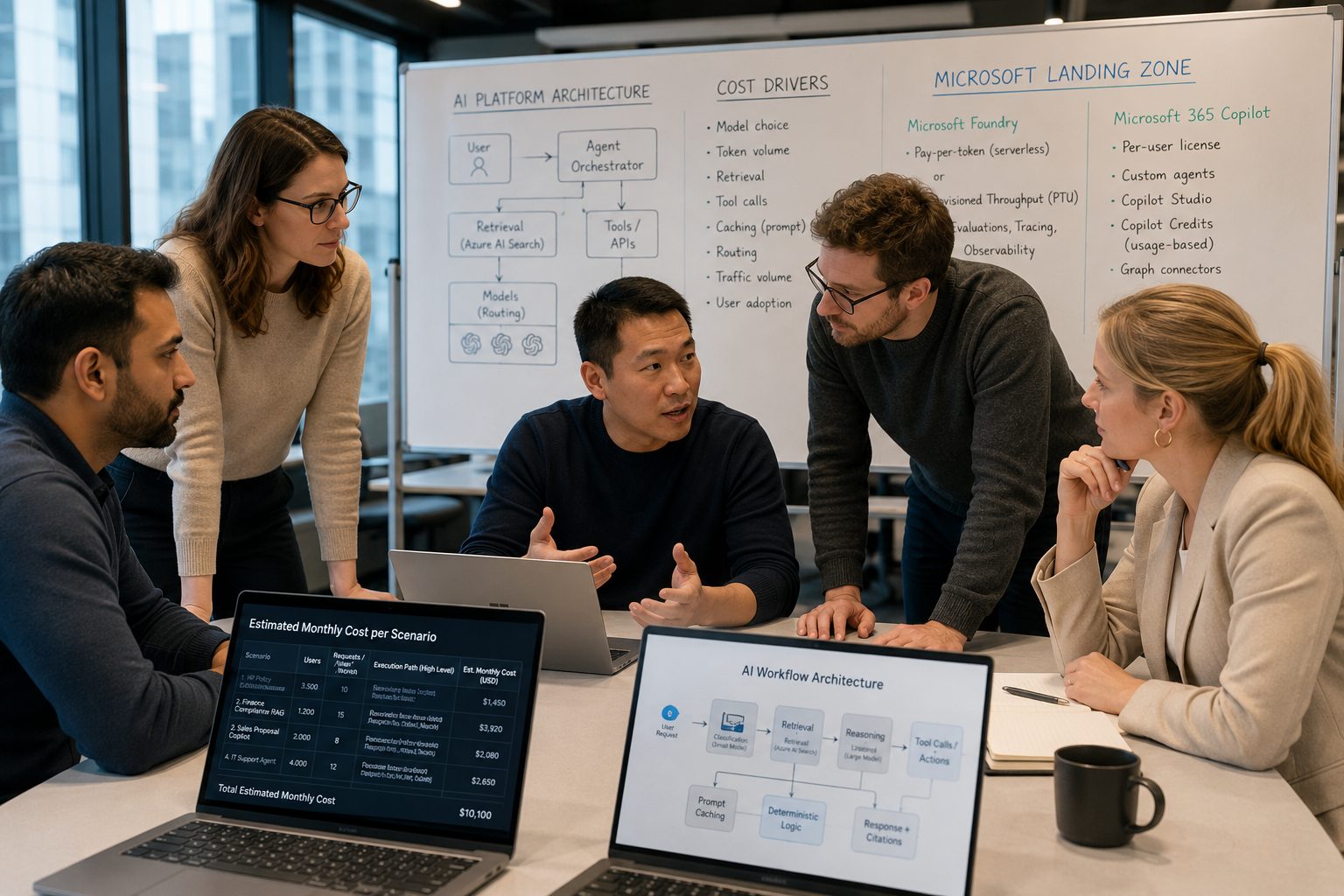
Estimate AI cost per business workflow, not per prompt: model every agent separately, include retrieval, tool calls, caching and routing, and separate Foundry consumption from the Microsoft 365 Copilot licensing model.
Key Points
- Why "what does a prompt cost" is the wrong question for an enterprise AI platform
- How the community shifted the discussion from model price to the route a request takes through the architecture
- Why Microsoft Foundry and Microsoft 365 Copilot have two different cost models
- The core message: estimate cost per business scenario, not per prompt
- Which architecture choices (small model, caching, deterministic logic, routing) structurally lower the bill
The Challenge
A customer wants to roll out AI across the organization. Some scenarios run on Microsoft 365 Copilot, others require custom agents in Microsoft Foundry. The CIO asks a seemingly simple question: "What will this cost per month?"
That answer turns out to be far more complicated than multiplying tokens by the model price. The original Reddit discussion was about generic LLM costs, but the underlying question is exactly what an enterprise architect asks before designing an AI platform. The question is not "how much does a model cost", but "how does a request flow through my architecture, and how often does that happen".
Community Discussion
The discussion quickly moved away from model pricing. Experienced participants stressed that token price is only one part of the equation. The real challenge is understanding how requests move through an AI architecture.
Recurring questions included: should every request reach the model, which steps can be deterministic, when is a small model sufficient, which prompts can be cached, how often does retrieval happen, which requests require reasoning, and what percentage of users actually invoke the AI.
Several participants noted that estimating "cost per prompt" is almost meaningless. Instead, they recommend estimating cost per business scenario. That shifts the question from a pricing exercise to an architecture exercise.
Microsoft Guidance
Microsoft's documentation focuses less on token prices and more on architecture. For Microsoft Foundry this includes prompt caching, model routing, evaluations, tracing and observability, the choice between serverless and provisioned deployment, and the trade-off between small models and reasoning models.
These concepts have direct cost impact. Prompt caching reduces latency and cost for prompts with an identical beginning: cache reads are billed at a discount on the input token price for standard deployments, and up to a full hundred percent discount on input tokens for provisioned deployments. Note: from gpt-5.6 onward, cache writes are billed separately on top of those discounted cache reads, so estimate with the rates of the model generation you actually deploy. The deployment type determines the billing model: a standard deployment bills pay-per-token (ideal for variable or unpredictable traffic), while a provisioned deployment is billed per PTU per hour and only pays off at predictable, high volume, especially combined with a reservation.
For Microsoft 365 Copilot the model looks different. Organizations generally purchase Copilot through licensing (the Microsoft 365 Copilot add-on per user) rather than paying directly per token. But custom extensibility, Microsoft 365 Copilot connectors and agents can still introduce costs depending on the architecture. Agents grounded only in instructions or public data incur no extra cost. Beyond that, two different consumption tracks run alongside each other and are often confused: Microsoft 365 Copilot Chat and SharePoint agents are billed through the Copilot Studio per-message meter on a linked Azure subscription, while Copilot Credits are a separate currency for Copilot Cowork and the Work IQ API that you manage in the Microsoft 365 admin center. A custom engine agent you host yourself adds hosting and model costs in Microsoft Foundry on top of that.
Architecture Perspective
One of the biggest mistakes is estimating AI costs from a single prompt. Real enterprise AI follows many different execution paths.
A typical Foundry agent performs retrieval, calls multiple tools, uses several models, executes deterministic logic, caches reusable context and returns citations. Not every request follows the same route. That turns cost estimation into an architecture exercise rather than a pricing exercise.
A second recurring recommendation was to split workflows into independent components, such as retrieval, classification, summarization, reasoning and tool calls. Each step can use a different model. Using a GPT-level reasoning model for every task often increases cost dramatically without improving business value. Classification and summarization can run comfortably on a small model, while you reserve reasoning for the steps that genuinely need it.
"This is not a pricing discussion. It is an architecture fit discussion."
The practical consequence: model every agent and every business scenario separately, add up the steps in the execution path, and estimate how often each path is taken and by how many users. Only then is a monthly figure grounded rather than a guess.
Key Takeaways
Estimate per scenario, not per prompt:
a single prompt says nothing about the cost of a multi-path workflow
Split the workflow:
retrieval, classification, summarization, reasoning and tool calls each deserve their own model
Reserve reasoning:
a reasoning model for every task raises cost without added business value
Know the two models:
Foundry bills consumption (per token or per PTU), Microsoft 365 Copilot runs primarily on per-user licenses
Watch Copilot's hidden Azure costs:
agents on tenant data and custom engine agents can still cost an Azure message meter, Copilot Credits or Foundry hosting
TechExplained Recommendation
Recommended when
- You are designing an AI platform with multiple scenarios across both Microsoft Foundry and Microsoft 365 Copilot
- A grounded monthly figure is needed before the build begins
- Workflows break down into clear steps (retrieval, classification, reasoning, tool calls)
- Traffic is predictable enough to weigh serverless against provisioned deployment
Not recommended when
- It concerns a single, isolated proof of concept with no production ambition
- There is no visibility yet into scenarios, user counts or execution paths
- The organization only buys Copilot licenses without custom agents or Microsoft 365 Copilot connectors
Related Content
Related Use Cases
Related How-tos