
|
Best PracticeLevel: Intermediate

Prompt engineering for RAG and agents

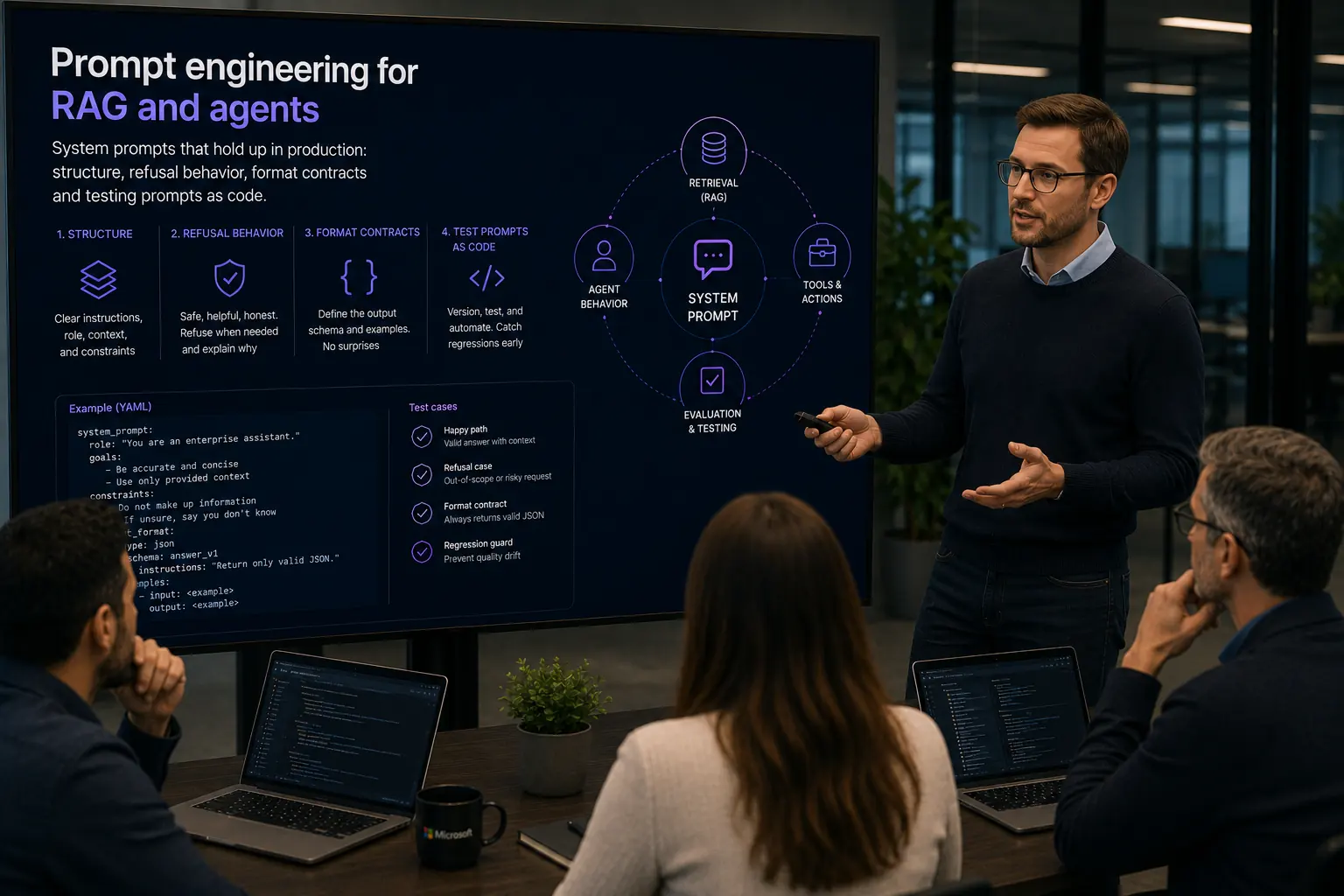
System prompts that hold up in production: structure, refusal behavior, format contracts and testing prompts as code.

TechExplained 1 min readPublished: 14 April 2026Last updated: 14 April 2026
#prompt engineering#rag#agents#evaluations
Architect walking a team through prompt engineering for RAG and agents: structure, refusal behavior, format contracts and testing prompts as code, on screen.
01

Treat prompts as code

Prompts belong in version control, with review and an evaluation set that runs on every change. The biggest quality incidents in production AI come from "just tweaked a word" without a test, exactly what we stopped accepting for code twenty years ago.

Version control

Prompts belong in Git, with history and traceability.

Every change runs the evaluation set

Treat prompts as code: in version control, with review and an evaluation set that runs on every change.

02

Structure beats prose

A good system prompt has recognizable blocks: role and context, the task, hard rules (what always and what never), the output format, and examples. Models follow structure better than long running text, and your team can review a structured prompt.

Models follow structure better than long running text, and your team can review a structured prompt.

03

Define refusal behavior explicitly

The most important rule in every enterprise prompt describes what the model does when the answer is not in the context: say so explicitly, and do not fill in from its own knowledge. Without that rule the model fills gaps with plausible nonsense, with a citation attached, which makes it extra convincing.

Model fills gaps itselfplausible nonsense
  • Fills missing knowledge from the model itself
  • Nonsense with a citation is extra convincing

Without a refusal rule / With explicit refusal

The most important rule describes what the model does when the answer is not in the context.

04

Be frugal with examples, generous with counterexamples

Two or three good examples steer more than ten. And one good counterexample ("for this question, refuse") prevents a category of errors that positive examples never cover.

Many positive exampleslittle extra steering
  • Ten examples barely steer more than three
  • Does not cover the error a counterexample catches

Ten examples / Sparing + counterexample

Be sparing with examples, generous with counterexamples. A good counterexample prevents a whole category of errors.

05

Format contracts are contracts

If the application expects JSON, describe the schema exactly and validate the output. Count on it going wrong one in so many times and build a recovery path (ask again with the error message) instead of hoping for perfection.

Request

The user request arrives at the agent or RAG pipeline.

Expect occasional errors, build a retry

If the application expects JSON: describe the schema exactly, validate the output and build a recovery path.

06

Shorter is usually better

Every extra instruction dilutes attention for the other instructions. Prune periodically: remove a line and see whether your evaluation set notices. Prompts grow organically; quality comes from pruning, not from stacking.

Adding instruction after instructiondiluted attention
  • Prompts grow organically and get messy
  • Each rule comes at the cost of the other rules

Stacked / Pruned

Every extra instruction dilutes attention for the others. Quality comes from pruning, not stacking.

The process at a glance

Click a step for its key decision

Summary

Treat prompts as code

Prompts belong in version control, with review and an evaluation set that runs on every change. The biggest quality incidents in production AI come from "just tweaked a word" without a test, exactly what we stopped accepting for code twenty years ago.

Prompt engineering for RAG and agents | TechExplained