
 Technology: Microsoft Fabric
Finance: demonstrable lineage for regulatory reporting
A financial institution consolidates a patchwork of services onto Fabric and builds controlled, demonstrably correct regulatory reporting with Warehouse, Purview lineage and Git-driven ALM.
Business challenge
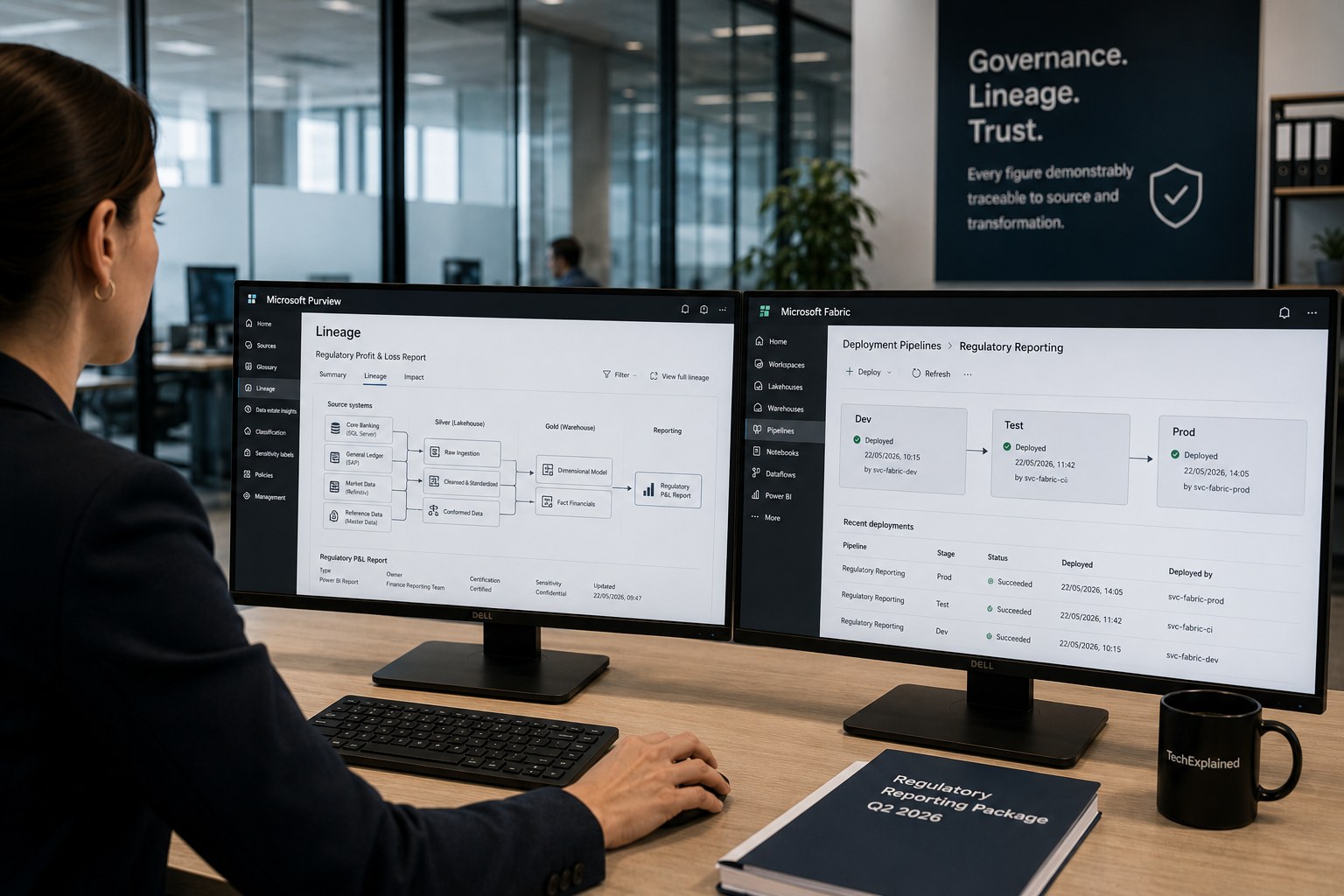
A regulated financial institution had to be able to demonstrably substantiate reports to its regulator: which source, which transformation, who had access. The existing environment was a patchwork of separate services, each managed, secured and audited on its own, which meant lineage was largely reconstructed by hand for every reporting cycle.
Architecture
Consolidation on Microsoft Fabric with a strict silver/gold separation following the medallion pattern. Controlled gold reports run in the Warehouse (T-SQL, multi-table transactions) rather than the Lakehouse, so there are hard guarantees on consistency within a single reporting run. Microsoft Purview tracks lineage automatically from source to report. OneLake Security governs access at column and row level, so sensitive positions are visible only to those with a role for it. All changes to pipelines and models go through Git integration and Deployment Pipelines, executed by a service principal, never manually in production.
Why this choice
The regulator does not ask for speed, it asks for reproducibility: can you show that every figure in the report comes about the same way, every time. That is exactly what Git plus Deployment Pipelines delivers, every change to a pipeline or model is a pull request with review, not a click in a portal nobody can reconstruct. Choosing the Warehouse over the Lakehouse for the gold layer gave the multi-table transactions financial reporting requires.
Alternatives
Keeping the existing patchwork of services and only improving the reporting layer did not solve the core problem: lineage stayed fragmented across systems that each kept their own audit trail. Bolting a fully external lineage platform onto the existing services created a second source of truth alongside the systems themselves, exactly the kind of inconsistency the regulator wanted to see disappear.
Trade-offs
- Reserved capacity for production is more expensive than pay-as-you-go, but gives the predictability a regulated environment requires.
- Strict separation between production and everything else means more environments to manage, not fewer.
- Every change going through a pull request slows down small tweaks; for a regulated institution that is a deliberate trade-off, not an unwanted side effect.
Microsoft products
Microsoft Fabric (Warehouse, Lakehouse, Git integration, Deployment Pipelines), Microsoft Purview (lineage, classification), OneLake Security, Microsoft Entra ID, Azure Key Vault for customer-managed keys.
Best practices
- Treat every change to production as a pull request with review, no exceptions, not even for "small" fixes.
- Choose the Warehouse for reports that need multi-table transactions and hard consistency guarantees; leave the Lakehouse for engineering.
- Let Purview lineage track automatically instead of documenting it by hand; manual documentation falls behind within a quarter.
Lessons learned
The biggest time savings did not come from faster reports but from less time spent reconstructing how a figure came about, that work largely disappeared because lineage is now captured automatically. An underestimated hurdle: service principals initially got overly broad roles to "just get it working", which auditors rightly flagged as a risk. Applying least privilege retroactively to existing automation took more time than getting it right from day one would have.
Architecture at a glance
Click a component for details
Source systems
Data from the existing patchwork of services lands unchanged in Bronze.
Microsoft Purview tracks lineage automatically from source to report, no more manual reconstruction per reporting cycle.
Related content
Related how-tos
Related best practices