
 Technology: Microsoft Fabric
Government: data mesh with delegated ownership
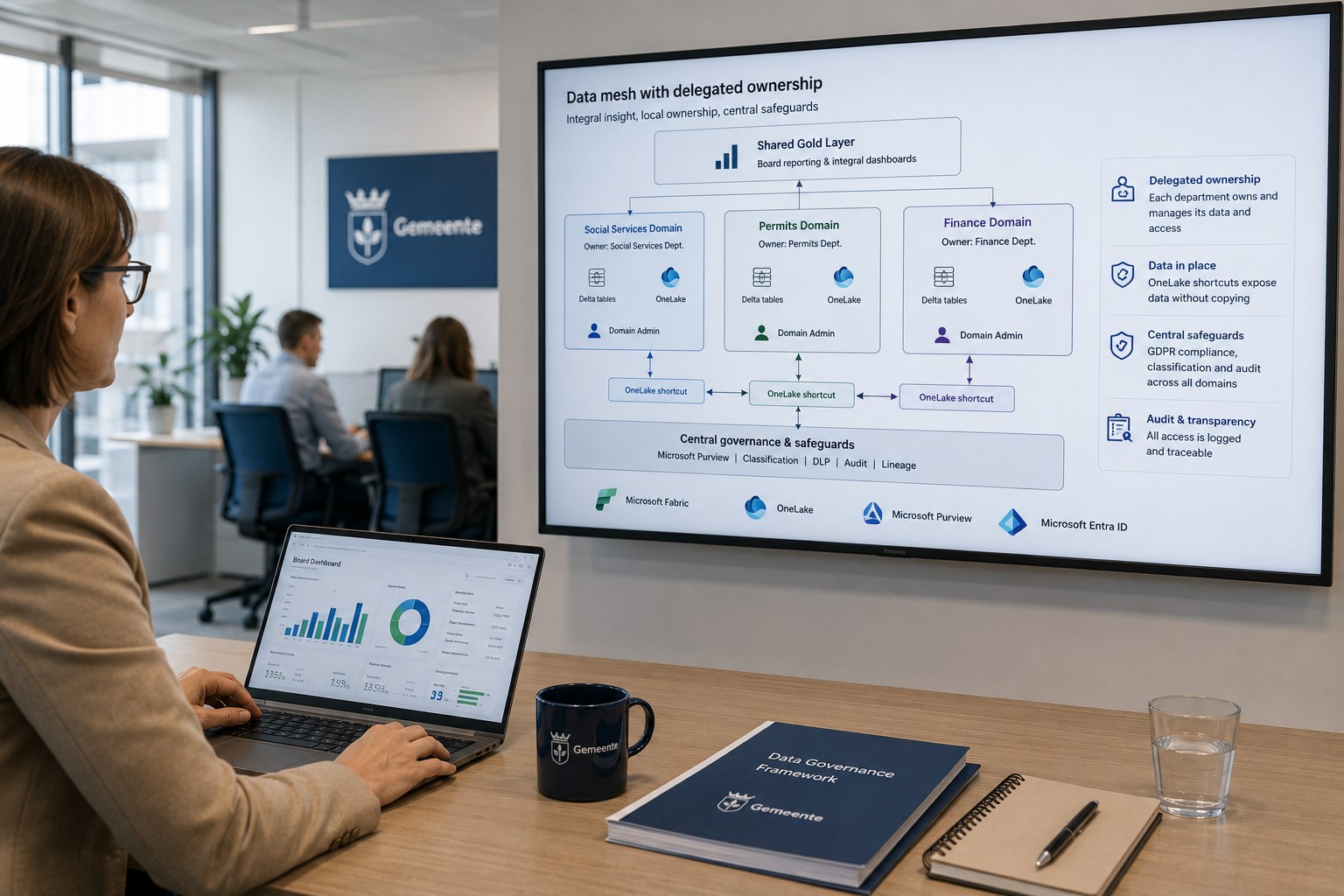
A municipality exposes department data as an integral view through Fabric domains and OneLake shortcuts, with delegated ownership per department and central GDPR safeguards.
Business challenge
At a mid-sized municipality, data sat isolated per department: social services, permits, finance, each with its own systems and its own reports. Leadership needed an integral view, but every centralization attempt ran into GDPR objections: departments wanted to stay owners of their own data, not hand it over to a central data team.
Architecture
Instead of one central data warehouse, every department got its own domain in Fabric, with its own workspaces and its own delegated domain admin. Departments publish their data as Delta tables in their own OneLake space; where other departments or leadership need that data, a OneLake shortcut exposes it in place, without a copy. A shared Gold layer for board reporting combines only the fields departments explicitly release. Microsoft Purview automatically classifies sensitive categories (special categories of personal data) and logs every access.
Why this choice
Data mesh with domains solved the actual conflict: leadership wanted oversight, departments wanted control. Because shortcuts virtualize data instead of copying it, no department had to "give away" its data; they stayed owners and managed themselves who could read along through a shortcut. Central governance (Purview, tenant policy) stayed intact without needing a central data team to manage everything.
Alternatives
One central data warehouse with a central management team was the starting point of earlier attempts, and stranded every time on ownership discussions: which department pays, who manages the definitions, who is responsible in a data breach. Fully separate platforms per department solved the ownership problem but made integral board-level insight impossible, exactly the problem that needed solving.
Trade-offs
- Shared capacity with chargeback per domain requires a clear cost split, or "who pays for capacity" becomes a new conflict.
- Shortcuts without governance agreements make access and lineage unclear; every shortcut had to be explicitly documented, not created ad hoc.
- Domain admins need platform knowledge that not every department has in-house; that called for training, not a technical fix.
Microsoft products
Microsoft Fabric (domains, workspaces, OneLake shortcuts), Microsoft Purview (classification, DLP, audit), Microsoft Entra ID.
Best practices
- Document which shortcuts exist and why; an ad-hoc patchwork of shortcuts is just as unmanageable as copies.
- Give every domain its own naming convention and documentation before the first workspace is created, not after.
- Automate classification with Purview instead of letting departments assign labels themselves; consistency outweighs autonomy on this point.
Lessons learned
The technical design was not the bottleneck, trust between departments was. Only once every department could see, through the audit trail, who was accessing their data through a shortcut did the reluctance to publish data disappear. Domain admins underestimated early on how much time naming discipline costs; without a documented convention, three different spellings for the same department appeared within a month.
Architecture at a glance
Click a component for details
Social services
Publishes its own Delta tables, exposed via a OneLake shortcut into the shared Gold layer.
Every department publishes in its own OneLake space; shortcuts expose data in place, nobody has to give data away.
Related content
Related how-tos
Related best practices