 Technology: Microsoft Fabric
Manufacturing: domain-driven lakehouse with a voice-first sales copilot
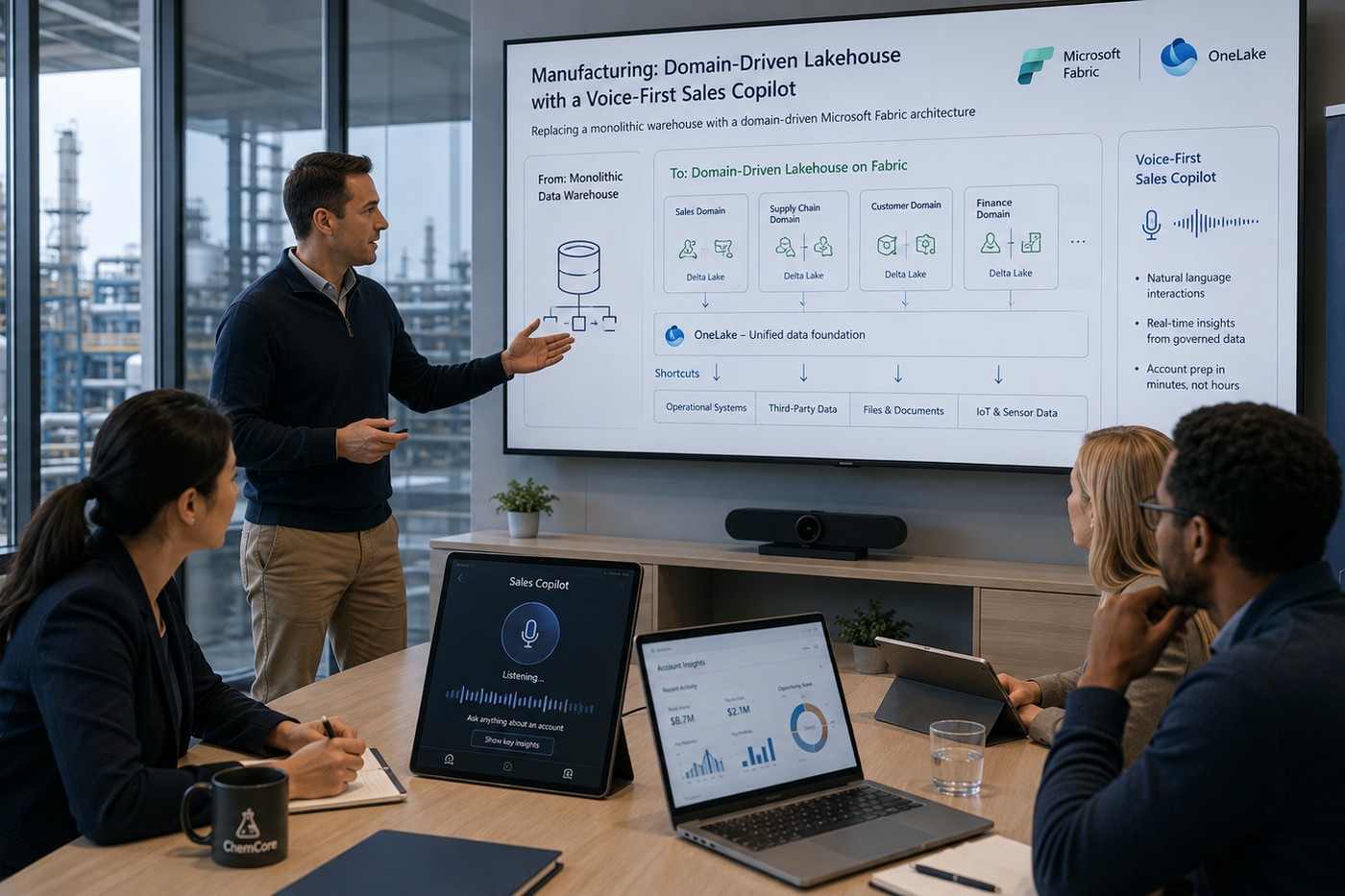
A chemical manufacturer replaces a monolithic data warehouse with a domain-driven Fabric architecture using OneLake shortcuts, then builds a voice-first sales copilot that cuts account prep from hours to minutes.
Business challenge
A chemical manufacturer with tens of thousands of employees had run on a monolithic data warehouse for years: one central ETL layer serving every domain. Customer data was scattered across price lists, contracts, spreadsheets, and call summaries. Sellers spent up to four hours per customer meeting hunting for the right information, and any new data need had to go through the same central team.
Architecture
The organization set up teams with their own Fabric workspace per domain, each owning its own data. OneLake shortcuts expose datasets across domains without copies: one team reads another team's data in place, with governance preserved at the source. Source data arrives through mirroring, gets transformed with dbt, and lands in a warehouse made available through shortcuts. On top of this layer runs a sales copilot: sellers speak or type a question, it gets translated into a SQL query against the warehouse in Fabric, and the result shows up in a dashboard with text, charts, and visuals that can be queried further. Microsoft Entra handles role-based access, so confidential research data stays visible only to those entitled to it.
Why this choice
A central data team could not scale to the demand of dozens of domains: every change ran through the same queue. A domain-driven architecture with OneLake shortcuts let each team iterate independently, without having to duplicate data to make it reusable.
Alternatives
A full rebuild of the central warehouse would have solved scalability eventually, but would take months before sellers noticed any difference. Separate BI reports per domain left the core question unanswered: sellers had no time to navigate dashboards during a customer call, they needed a direct answer.
Trade-offs
- Domain-owned workspaces give teams autonomy, but require a shared agreement on naming and quality, otherwise inconsistent definitions emerge across domains.
- A sales copilot that generates SQL queries works well for factual questions, but needs a separate approach such as vector search for questions that turn on meaning rather than precise counts.
- Role-based access through Entra protects confidential data, but has to be built into the domain design from the start, not bolted on afterward.
Microsoft products
Microsoft Fabric (OneLake, mirroring, warehouse), Azure OpenAI in Microsoft Foundry Models, Microsoft Entra.
Best practices
- Let each domain team own its own data and quality, expose it with shortcuts rather than spreading copies around.
- Combine SQL queries for factual, precise questions with vector search for questions that turn on context or similarity.
- Build role-based access through Entra into the domain design from the start, so sensitive data is never available more broadly than needed.
Lessons learned
The biggest time savings did not come from a faster dashboard, but from removing the search itself: sellers no longer had to switch between systems to find an answer. Prep time per customer meeting dropped from hours to minutes once the answer was one question away instead of spread across five sources.
Architecture at a glance
Click a component for details
Domain teams
Each team manages its own Fabric workspace and warehouse via mirroring and dbt.
Every domain team keeps ownership of its own data; shortcuts expose that data to other teams without copies.
Related content
Related how-tos
Related best practices