
 Technology: Microsoft Fabric
Manufacturing: predictive maintenance from sensor data
An international manufacturer connects sensor data via Eventstream and Eventhouse to machine learning for failure prediction, cutting unplanned downtime with data-driven maintenance.
Business challenge
An international manufacturer with multiple plants struggled with unplanned downtime from machine failures. Sensor data was collected but barely used, maintenance happened on fixed schedules instead of actual machine condition, which meant maintenance was both too early and too late.
Architecture
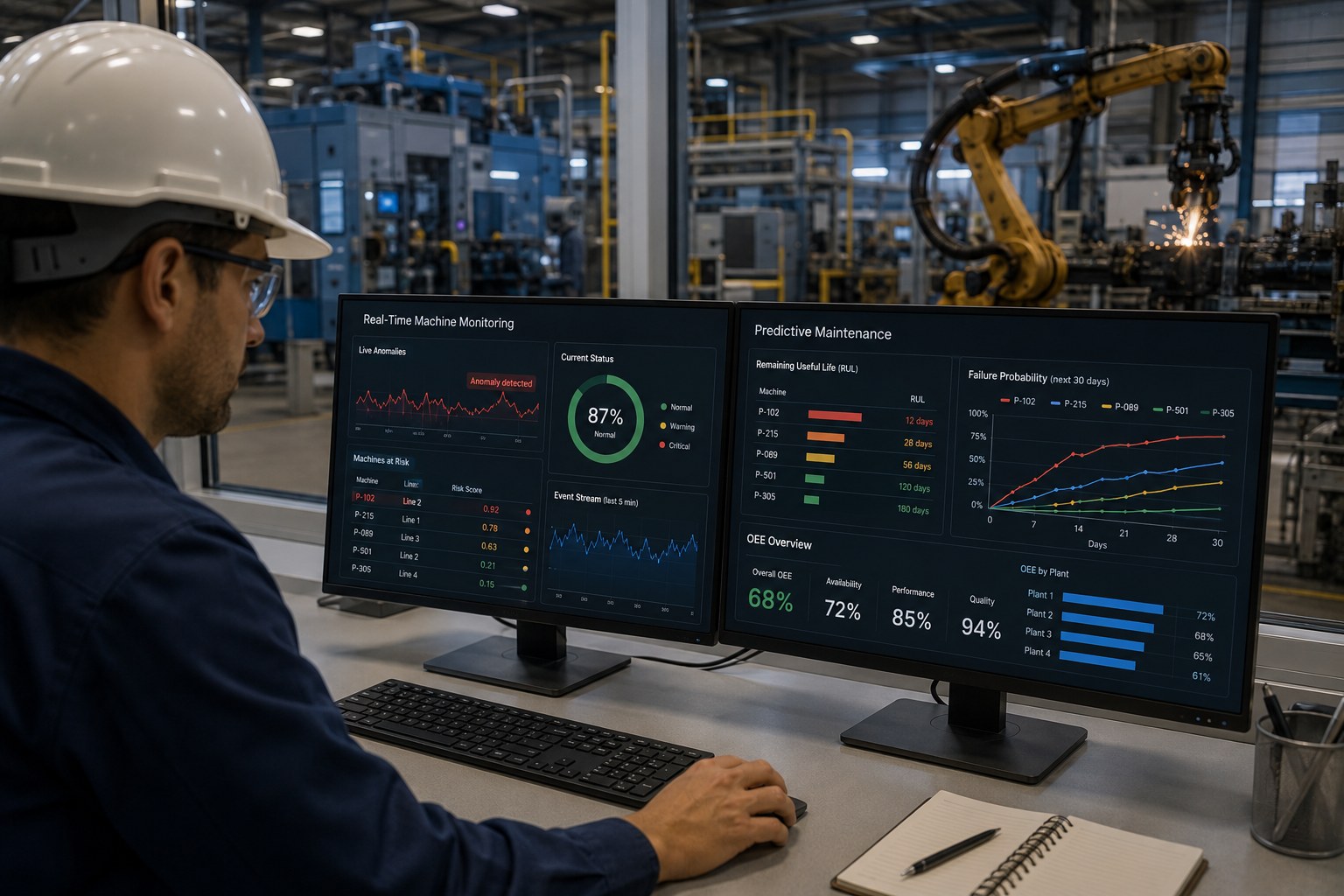
IoT sensors feed an Eventstream per plant, which flows into an Eventhouse for KQL-based anomaly detection in sub-second time. Activator translates deviating patterns into maintenance triggers for the maintenance team. In parallel, machine learning models train on historical sensor data to estimate remaining useful life per machine component. A Gold layer with OEE (Overall Equipment Effectiveness) figures is exposed via Direct Lake in Power BI dashboards per plant.
Why this choice
Sub-second streaming and ML training on the same platform data meant no separate data pipeline was needed between "real-time detection" and "predictive model", both read from the same OneLake layer. For a manufacturer with multiple locations and varying connectivity, one platform with a predictable capacity model was simpler to manage than a collection of separate edge and cloud solutions per plant.
Alternatives
An edge-only solution per plant gave lower latency for local detection, but made it impossible to compare patterns across plants, and every plant would have to retrain its own maintenance model from scratch. A separate streaming service next to a separate ML platform solved the technical problem but doubled the security and management burden, exactly what a lean maintenance team could not carry.
Trade-offs
- Streaming capacity has to be sized for peak load per plant, not the average; undersizing means missed detections at exactly the moments that matter.
- Machine learning for remaining useful life needs enough historical failure data; new machines initially yield weaker predictions.
- Segmentation per plant (separate workspaces, OneLake Security) adds management overhead, but was needed to isolate OT networks from one another.
Microsoft products
Microsoft Fabric (Eventstream, Eventhouse, Activator, Data Science with ML and MLflow), OneLake with OneLake Security, Power BI with Direct Lake.
Best practices
- Fire alerts on a stabilized deviation over a window, not on every single reading; otherwise the maintenance team drowns in false alarms.
- Isolate per plant at workspace and security level, with Private Link to the OT network, instead of cramming everything into one shared environment.
- Treat remaining-useful-life models as a growing model, not a one-time deliverable; every new failure is training data.
Lessons learned
The biggest savings did not come from predicting failures that were already visible anyway, but from removing unnecessary scheduled maintenance on machines that did not need it. A hard lesson: Activator is suited to operational alerts, but not to safety-critical emergency stops, that function belongs in a deterministic PLC/SCADA layer, and that distinction had to be made explicit before a team felt the temptation to combine them anyway.
Architecture at a glance
Click a component for details
Sensors per plant
IoT sensors feed an Eventstream per plant.
Activator suits maintenance triggers, not safety-critical emergency stops, that belongs in a separate PLC/SCADA layer.
Related content
Related how-tos
Related best practices